Date
As confirmed by two of the co-leads of FOMO2026, Stefano Cerri, Postdoctoral Researcher at the Pioneer Centre for AI and at the Copenhagen Research Centre for Biological and Precision Psychiatry and Jakob Ambsdorf, Postdoctoral Researcher at the Department of Computer Science, University of Copenhagen, and the Pioneer Centre for AI, hospitals are producing more medical images than ever, while radiologists remain in short supply. Rather than replacing specialists, AI researchers are increasingly focused on a different question: how can AI help healthcare professionals cope with growing workloads while maintaining the extraordinarily high standards required in clinical practice?
This question sits at the centre of one of the fastest-growing areas of medical AI research: foundation models.
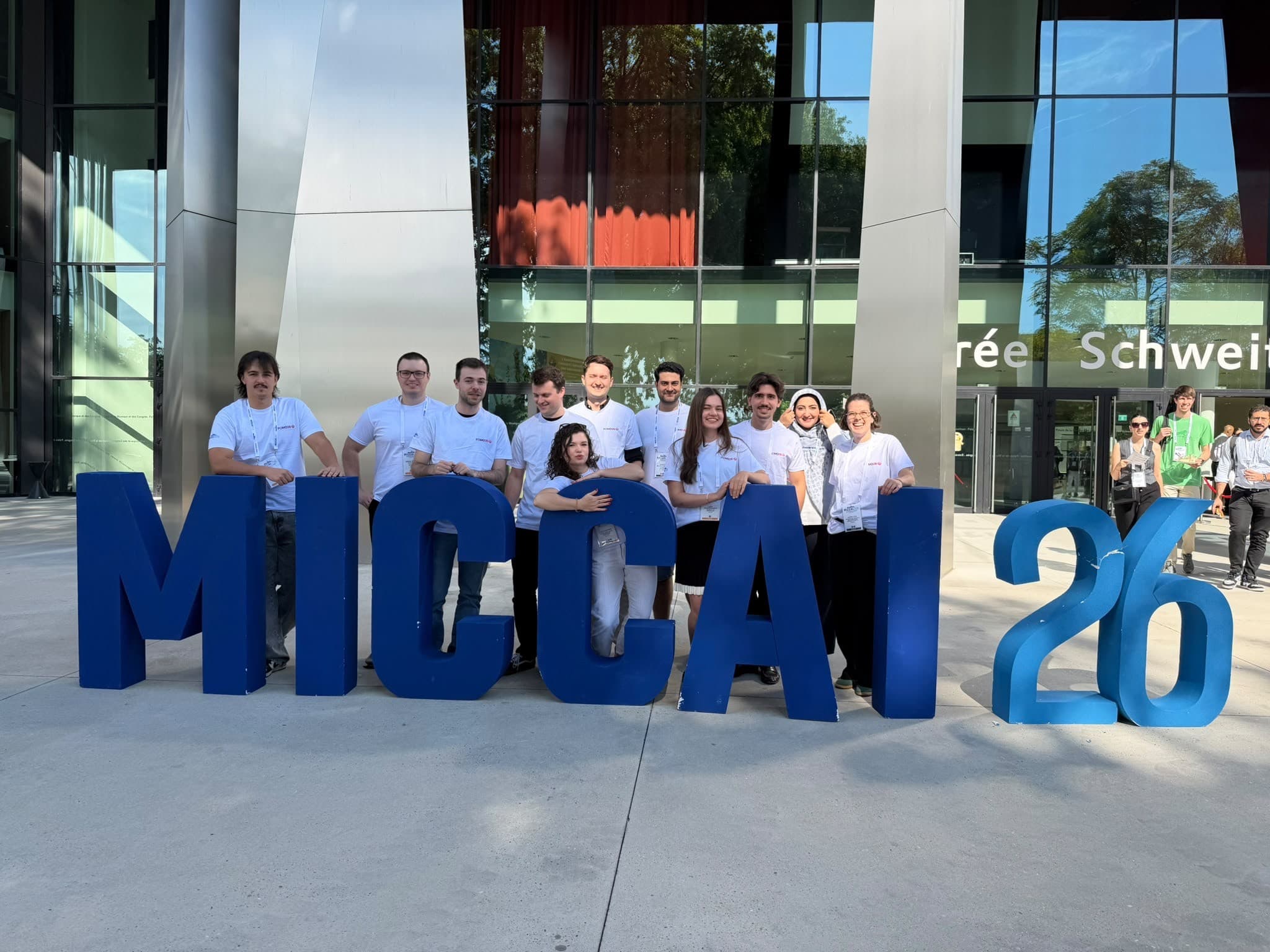
It is also the motivation behind FOMO2026, the Foundation Model Challenge for Brain MRI, organised by researchers from the Pioneer Centre for AI and partner institutions.
The challenge reflects a field in transition.
Only a few years ago, most medical AI research focused on highly specialised models trained to solve a single task. These systems often performed impressively under controlled conditions but struggled when confronted with the realities of clinical practice. A model trained in one hospital could already perform worse in the hospital next door. Move it to another country, another scanner or another patient population, and the performance often dropped further.
The problem was robustness.
Foundation models promise a different path. Instead of learning a single task, they are trained on large and highly diverse collections of data, allowing them to learn broader patterns that can later be adapted to a wide range of applications.
Whether that promise can be realised remains an open question.
That is where FOMO comes in.
One of the biggest obstacles in foundation model research is simply getting started.
Training large-scale models requires data, infrastructure and computational resources that are often beyond the reach of individual researchers or smaller groups. Even when data exists, it is frequently scattered across repositories and stored in different formats that make it difficult to use.
The organisers of FOMO wanted to change that.
They spent months collecting publicly available brain MRI datasets and standardising them into a format that participants could access immediately. Alongside the data, they provided code and infrastructure designed to help researchers begin experimenting almost immediately.
In doing so, they lowered the entry point to the field.
As Stefano explains:
Getting started shouldn't be the hard part. We wanted to lower that barrier as much as we could, so we gave people both the data and the code to train these models, so they could start experimenting right away.
At the same time, they deliberately made the scientific challenge more difficult.
Rather than designing tasks that rewarded narrowly specialised models, the competition was built around large and heterogeneous datasets reflecting the complexity of real-world healthcare environments. Success depended not on excelling in a single setting but on developing methods capable of generalising across many different settings.
If lowering the entry point was one objective, raising the bar was the other.
As Jakob explains:
Foundation models promise to work across many tasks and clinical settings. With FOMO26, we wanted to put that promise to the test, and measure progress on hard problems representing the diversity of the real world.
Together, these ideas became the defining principle of the challenge.
The response from the research community suggests the approach is resonating.
When the first edition of FOMO was organised in 2025, participation was far from guaranteed. Foundation models were still a relatively niche topic within medical imaging.
Just one year later, the number of participating teams increased from 16 to 42. What had started as a small initiative suddenly required one of the conference's larger rooms.
The growth mirrors a broader development within the field. According to the organisers, foundation models have moved from being a niche research interest to becoming one of the dominant themes in medical AI.
Yet the results also revealed how early the field remains in its development.
None of the challenge tasks were fully solved.
Far from being a disappointment, that outcome may be one of the competition's most valuable findings.
The tasks were intentionally designed to be difficult. The goal was not to demonstrate that foundation models have already solved the field's challenges but to create a benchmark against which genuine progress can be measured.
In that sense, FOMO did exactly what it was intended to do: provide a clearer picture of both the opportunities and the limitations that currently define foundation model research.
That perspective also explains why the organisers describe FOMO less as a competition and more as a service to the research community.
The challenge generates no commercial product and pursues no direct economic objective. Its value lies in creating shared resources, shared benchmarks and a shared meeting place for researchers working on common problems.
The broader value of initiatives like FOMO extends beyond any single competition. According to Mads Nielsen, Professor at the Department of Computer Science, University of Copenhagen, Co-Lead of the P1 Collaboratory “Fine-grained Analysis”, and Chair of the Scientific Committee of FOMO, challenges of this kind help strengthen the research ecosystem itself.
The challenge helps progress science in several ways, especially by enabling talent from all over the world to contribute and by making benchmarking more standardised. We are creating a community.
As interest continues to grow, the next challenge may be one of scale. The organisers hope to attract more international partners and broaden the geographical and clinical diversity represented in the evaluation process, enabling a more comprehensive assessment of how foundation models perform across different populations and healthcare settings.
For the Pioneer Centre for AI, this collaborative approach reflects the centre's broader mission. Progress on socially important challenges cannot be achieved by individual researchers or institutions working in isolation. It depends on communities, shared infrastructure and collective effort.
FOMO therefore represents more than a technical exercise.
It is an attempt to make participation easier, expectations higher and progress more accessible to the field as a whole.
To lower the entry point while raising the bar.
Behind that ambition lies the work of a team of researchers committed not only to advancing their own research, but also to creating the infrastructure, benchmarks and community resources that enable others to contribute. In that sense, FOMO26 reflects a broader belief shared across the Pioneer Centre for AI: that meaningful scientific progress is most durable when it is built collectively.