Date
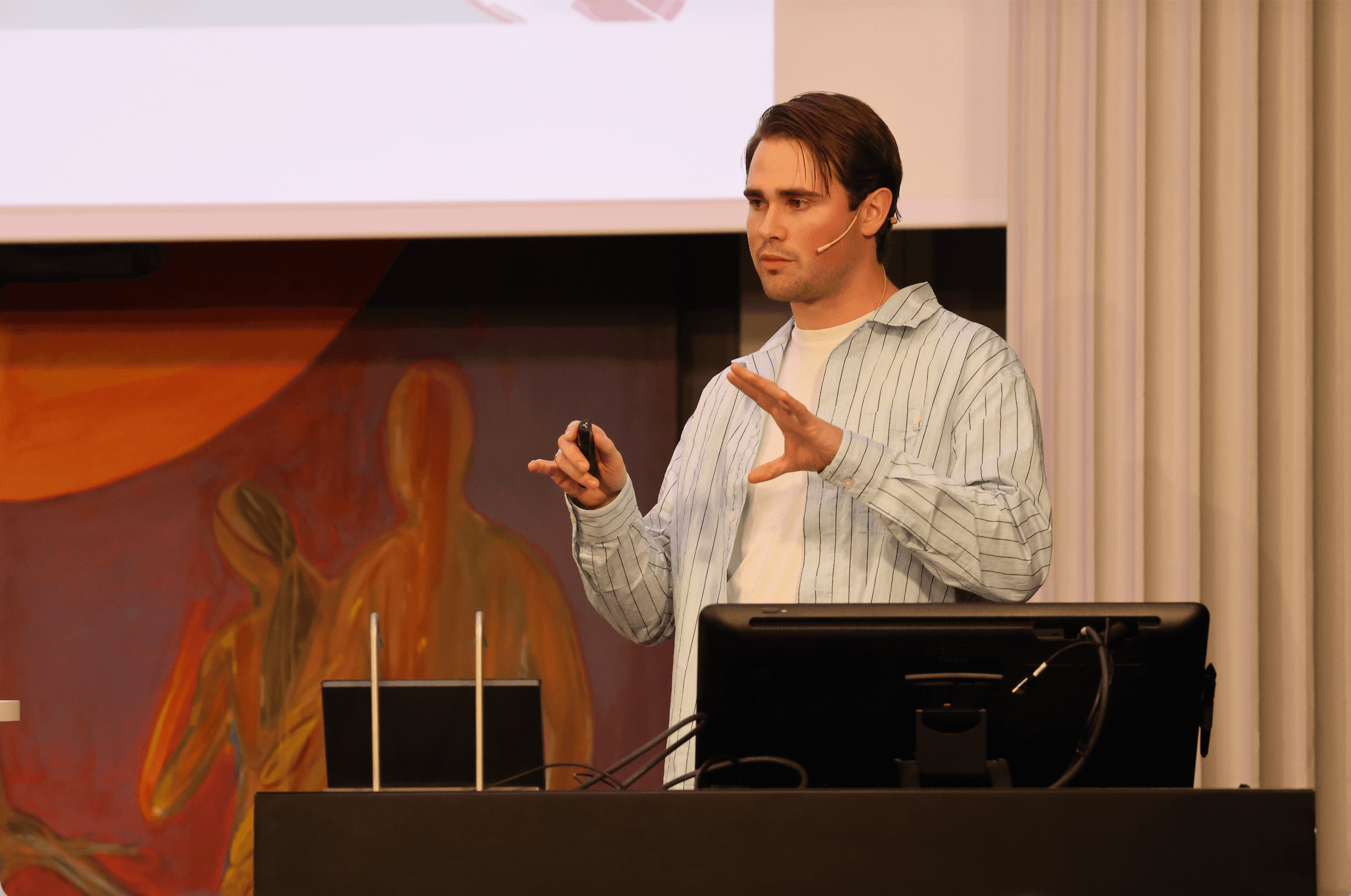
Get to know Sander Riisøen Jyhne
Current position & Affiliation
PhD Student in Machine Learning at the Norwegian Mapping Authority and University of Agder.
Area of research
My PhD research is in computer vision, with a particular focus on developing machine learning methods for understanding and reconstructing information from aerial imagery, including tasks such as segmentation, super-resolution, and 3D reconstruction.
Supervisor(s)
Morten Goodwin, Professor at the University of Agder, Per-Arne Andersen, Associate Professor at the University of Agder, Ivar Oveland, the Norwegian Mapping Authority, and Nico Lang, Assistant Professor at the University of Copenhagen.
Reflections on the exchange experience at P1
The research stay at P1 was wonderful, with great colleagues and a beautiful working environment at the observatory in Copenhagen. There was always someone in the office available for discussions about recent or ongoing projects. The group consisted of people with great width of expertise, which was super helpful during group discussions. I travelled with my family for one year, and we had a great time living in the city, and have ended up longing back after ending the stay in the summer of 2025.
What made the collaboration particularly valuable?
Through this collaboration, I worked closely with Nico Lang on a super-resolution method for burst imagery, such as Sentinel-2 data. The stay also enabled valuable sparring with other PhD students, post-docs, and professors. In addition, Serge Belongie and Christian Igel from DIKU made crucial contributions to the project using their deep expertise of the field.
How did it impact your professional network and future research?
The collaboration significantly expanded my professional network, connecting me with extremely skilled researchers, some of whom I have also become good friends with. The collaboration resulted in extending my supervision team with Nico Lang, which has been extremely valuable for the continuation of my PhD.
The visit was part of a Nordic exchange initiative emerging from year-long collaboration with P1 Faculty Robert Jenssen, Professor at Visual Intelligence, The Arctic University of Norway.
About SuperF: Neural Implicit Fields for Multi-Image Super-Resolution
Abstract
High-resolution imagery is often hindered by limitations in sensor technology, atmospheric conditions, and costs. Such challenges occur in satellite remote sensing, but also with handheld cameras, such as our smartphones. Hence, super-resolution aims to enhance image resolution algorithmically. Since single-image super-resolution requires solving an inverse problem, such methods must exploit strong priors, e.g. learned from high-resolution training data, or be constrained by auxiliary data, e.g. by a high-resolution guide from another modality. While qualitatively pleasing, such approaches often lead to hallucinated structures that do not match reality.
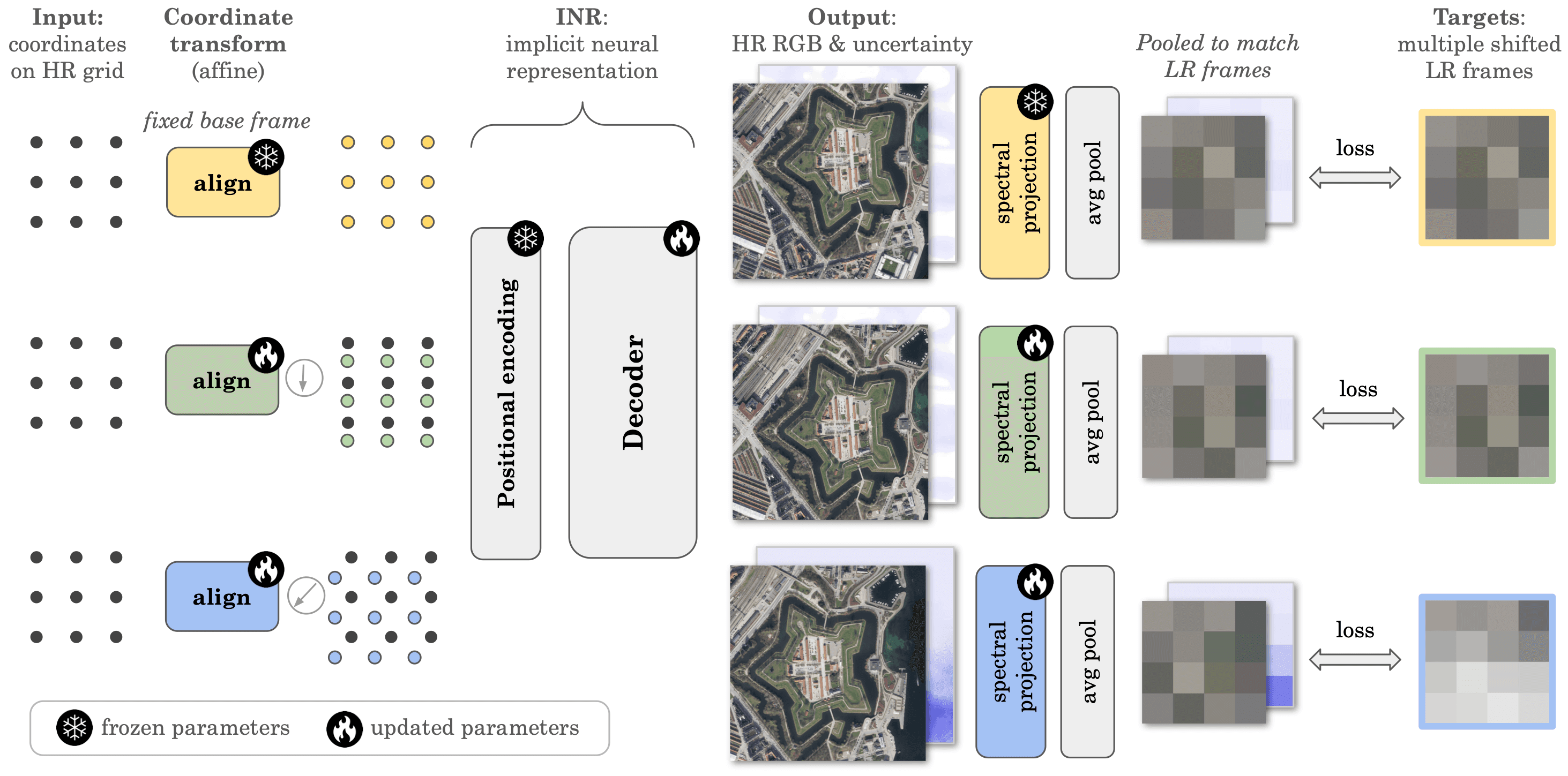
In contrast, multi-image super-resolution (MISR) aims to improve resolution by constraining the reconstruction with multiple views taken with sub-pixel shifts. We propose SuperF, a test-time optimization approach for MISR that leverages coordinate-based neural networks, also called neural fields. Their ability to represent continuous signals with an implicit neural representation (INR) makes them an ideal fit for the MISR task. The key characteristic of our approach is to share an INR for multiple shifted low-resolution frames and to jointly optimize the frame alignment with the INR. Our approach advances related INR baselines by directly parameterizing the sub-pixel alignment as optimizable affine transformation parameters and by optimizing via a super-sampled coordinate grid that corresponds to the output resolution. Our experiments yield compelling results on simulated bursts of satellite imagery and ground-level images from handheld cameras, with upsampling factors of up to 8. A key advantage of SuperF is that this approach does not rely on any high-resolution training data.
Authors
Sander Riisøen Jyhne, PhD Student at the Norwegian Mapping Authority and University of Agder, Christian Igel, Professor at the Department of Computer Science, University of Copenhagen and P1 Co-lead of the Learning Theory and Optimisation Collaboratory, Morten Goodwin, Professor at the University of Agder, Per-Arne Andersen, Associate Professor at the University of Agder, Serge Belongie, P1 Director and Professor at the Department of Computer Science, University of Copenhagen, and Nico Lang, Assistant Professor at the Department of Computer Science, University of Copenhagen.
Find more information about SuperF here.
Figure 1: Overview of the SuperF method, showing the shared implicit neural representation, frame-specific alignments, and super-resolved reconstruction.